
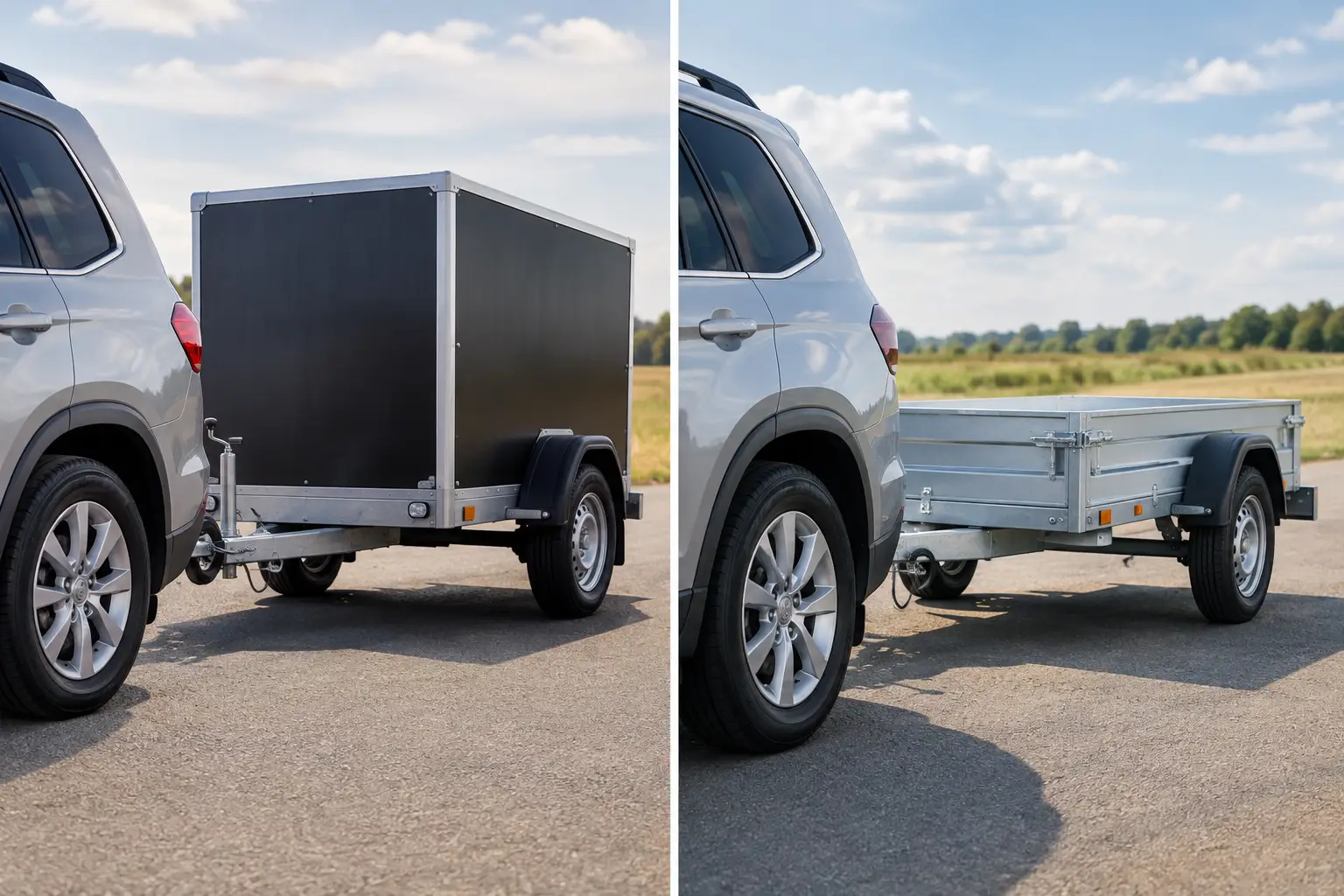
A trailer that is easy to tow empty can become a very different machine once it is loaded with machinery, green waste, timber, tools, or a side-by-side. That is where the braked trailer versus unbraked decision matters. It is not simply a question of price. It affects what you can legally carry, how the trailer behaves under braking, and whether your setup is suitable for the work you rely on it to do.
For light, occasional jobs, an unbraked trailer can be practical and economical. For heavier loads, regular towing, hills, traffic, or work where stopping distance matters, trailer brakes are usually the sensible option. The right answer starts with your real loaded weight, not the load you hope to carry on a quiet weekend.
Braked trailer versus unbraked: the basic difference
An unbraked trailer has no independent braking system. When the tow vehicle slows, the trailer slows because it is attached to the vehicle. The tow vehicle’s brakes do all the work for both.
A braked trailer has brakes fitted to the trailer wheels. Depending on the trailer design and rating, these may be mechanical override brakes, electric brakes, or a hydraulic system. When you apply the tow vehicle brakes, the trailer contributes to the stopping effort instead of pushing all its momentum into the back of the vehicle.
That difference becomes clear quickly when a load is close to the trailer’s limit. A loaded box trailer carrying pavers does not stop like an empty garden trailer. Nor does a plant trailer carrying a compact excavator behave like a trailer carrying a few bags of mulch.
Legal weight limits come first
In New South Wales, an unbraked trailer is limited to an aggregate trailer mass, or ATM, of 750 kg. ATM is the maximum permitted weight of the trailer and its load. It is not just the payload. The trailer’s own weight is part of that number.
This catches many buyers out. A trailer that weighs 300 kg empty only has 450 kg available before it reaches a 750 kg ATM limit. Add a cage, ramps, spare wheel, toolbox, or a few upgrades, and the usable payload can shrink further.
Trailers above 750 kg ATM require brakes. The exact braking setup depends on the trailer’s rating and configuration. Trailers over 2,000 kg ATM have further requirements, including brakes on all wheels and a breakaway system designed to apply the trailer brakes if it becomes disconnected.
Legal compliance is only one part of the decision. Your tow vehicle also has limits for braked towing capacity, unbraked towing capacity, towball download, gross combination mass, and axle loads. The lowest applicable rating sets the limit. A trailer may be engineered to carry the load, but that does not mean every vehicle can legally or safely tow it.
When an unbraked trailer makes sense
An unbraked trailer is not automatically a poor choice. It can be the right tool for genuinely light work. Small household runs, light garden equipment, occasional furniture collection, and compact recreational loads can all suit an unbraked trailer when the fully loaded weight stays comfortably below 750 kg.
They are generally simpler to own. There are fewer components to service, no brake controller to install, and a lower upfront cost. They can also be easier to move around by hand, particularly if the trailer is compact and stored in a tight driveway or shed.
The key word is comfortably. Buying an unbraked trailer because you think you will only exceed its limit once in a while is a poor plan. Loads grow. A small landscaping job can turn into wet green waste, soil, edging, and equipment. A weekend renovation can mean timber, sheet goods, fixtures, and tools all on the same trip.
If the trailer will regularly be loaded near its maximum, a higher-rated braked trailer may give you more usable capacity and a much better safety margin.
Why a braked trailer earns its keep
Braked trailers are built for loads that place real demands on the towing setup. The main benefit is controlled stopping. By braking at the trailer wheels, the system reduces the tendency for a heavy trailer to shove the tow vehicle forward under hard braking.
That matters in Sydney traffic, on wet roads, and on the descents and uneven back roads common around the Hawkesbury and regional New South Wales. It also matters when an unexpected stop is needed. No braking system removes the need for safe following distances and sensible speeds, but a correctly maintained braked trailer gives the driver more control when the situation tightens up.
A braked trailer also opens the door to higher ATM ratings and more useful payloads. That may suit a contractor hauling tools and materials, a farmer moving equipment around a property, or a recreational owner carrying a boat, camper, or off-road vehicle. In these cases, the extra cost is usually small compared with the cost of an overloaded, unsuitable trailer or a missed workday caused by a preventable problem.
There are trade-offs. Braked trailers cost more to buy and require regular inspection and maintenance. Electric brakes need a compatible brake controller in the tow vehicle. Mechanical and hydraulic systems need adjustment, checks, and replacement parts as they wear. That is not a reason to avoid them. It is a reason to buy the right setup and service it properly.
Do not choose by trailer size alone
Two trailers can look nearly identical and have very different capacities. One may be a light-duty unbraked box trailer intended for household use. The other may have a stronger chassis, upgraded suspension, brakes, a higher ATM, and a payload suited to commercial work.
Before deciding, work through the whole job. Consider the heaviest load you will realistically carry, including accessories and anything stored permanently on the trailer. Check where you tow, how often you tow, and whether the load is dense or likely to move. A trailer full of dry branches is different from the same volume of wet soil or crushed rock.
Also consider load placement. A legal trailer can still tow badly if the weight is positioned incorrectly. Too much weight behind the axle can cause sway. Too little towball weight can make the trailer unstable. Too much towball weight can overload the vehicle’s rear axle or exceed the hitch rating. Brakes help, but they do not fix poor loading.
Brake type should suit the trailer’s work
For lighter braked trailers, mechanical override brakes may be suitable. These apply when the trailer pushes forward against the coupling during braking. They are a straightforward option for certain applications, but they have limits in feel and control.
Electric brakes are common on many work and recreational trailers because the driver can adjust braking response through a controller. Set up correctly, they offer useful control across changing loads and road conditions. They do require proper installation, wiring in good condition, and a controller matched to the tow vehicle.
For heavier applications, hydraulic and breakaway systems may be part of the required design. The important point is not choosing a brake system because it sounds impressive. It is selecting one that meets the trailer’s legal rating and suits its actual use.
Build for the load you will actually carry
A cheap trailer becomes expensive when it limits your work, needs repeated patch repairs, or leaves you guessing about safety every time it is loaded. The better approach is to specify the trailer around the job: chassis strength, suspension, brakes, ramps, tie-down points, cage height, axle rating, and usable payload all need to work together.
If you are comparing a braked trailer versus unbraked trailer for a new purchase, bring the likely load figures with you. Include the weight of machinery, attachments, fuel, tools, and any permanent additions. A proper assessment can prevent buying a trailer that is technically legal empty but wrong for the work.
AJF Trailers can help match braking, structure, and capacity to how you tow, whether that means a straightforward light trailer or a custom-built work setup. The aim is simple: a trailer that stops properly, carries what it should, and stays dependable when the job cannot wait.
Before you commit, weigh the load you expect to carry most often, check every rating on the trailer and tow vehicle, and leave room for the work to grow. The right trailer should make the next job easier, not create another limit to work around.